Kiara’s Six Year Adventure

Kiara’s older sibling used to tell her she was adopted. A stranger at the DMV told her the same thing. It turns out, they were both wrong. When Kiara Fraizer was young, her older sister tried to convince her she was ‘born on a ship in a pile of doo-doo.’  Kiara wrote it off as annoying and typical sibling behavior and never thought it would come back to haunt her – until she went to obtain her Florida gold star ID. Born and raised in Ohio, Kiara never had any issues getting her ID, but when she showed the clerk her documents to obtain her Florida REAL ID it was clear something was wrong. Kiara’s last names on her Social Security card and birth certificate were different. One document had her father’s last name and the other had her mother’s last name. Confused and bewildered, Kiara could only stare at the two documents while the clerk attempted to explain why this could be happening.

“This [discrepancy] usually happens when you get an amended birth certificate, so you’re adopted,” the clerk told her.  Suddenly, she could hear her sister’s words taunting her, “You were born on a ship in a pile of doo-doo, and you were adopted!” But still, Kiara knew this was not true.

In fact, the reasoning for her mismatched documents was much simpler. Her parents had an argument and her dad’s name ended up being omitted from her birth certificate. Thus, the last name on her birth certificate was listed as her mother’s. However, when Kiara got her Social Security card, her last name was listed as her father’s. So there was no record of how her name went from Harris to Fraizer. Now, years later as a single mom with two kids, Kiara needed her gold star Florida ID since she is no longer a resident of Ohio. “I went [to apply] for rental assistance and I got denied because I didn’t have a Florida ID [my Ohio ID wouldn’t work]. Everything else went through but I didn’t have that ID.”

Proving Kiara Fraizer and Kiara Harris were one and the same became a struggle. Five years passed as Kiara searched for a way to fix her mismatched last names. Kiara spoke to her mom, who recommended IDignity where her mom had previously received her ID.

Kiara worked with the two lawyers on staff, Kelly and Sharlene (pictured above), for a few months. “The process just started immediately, no fees, no anything. They knew exactly what to do from day one. This was a big, big milestone because it was a hindrance in my life.”

After going in front of a judge to get her name change approved, Kiara was able to amend her birth certificate to list her last name as Fraizer. Now, Kiara is able to get her gold star Florida ID, be REAL ID compliant, and get her kids into school without any issues.

“They [school officials] want to see your birth certificate to prove you are their parent. I had to tell them the whole story. It looked like I was two people because I had two last names; my kids were Fraizer and I was Harris.”

Finally, after nearly six years, Kiara’s last name matched her identification documents. “[I] feel complete. Having Fraizer on my birth certificate makes me complete and whole with my dad and my family. I’m telling you, IDignity has completed my family. I can call my dad and tell him I will have Fraizer on my birth certificate now!”

In addition, Kiara can now tell her sister that she was NOT born on a ship in a pile of doo-doo!

Celebrating Black History Month!

February is Black History Month and to celebrate IDignity wanted to share some fantastic Orlando History and notable figures in our community and their significant contributions.

DID YOU KNOW?

  • Paul C. Perkins was the first African American to be appointed and serve as the City Prosecutor in 1965.
  • The first African American to be elected to the Florida House of Representatives, Dr. Alzo Reddick, was ALSO the first African American in the state of Florida to pass a constitutional amendment – and he did it TWICE!
  • The Headquarters of the Orlando Police Department was previously the Holden Street Elementary School. This school was built in 1935 and was the first school for Orlando’s African American students in grades 1st through 4th. 
  • The pitcher’s mound of Tinker Field is where Dr. Martin Luther King, Jr. gave his one and only speech in Central Florida, “Integration Now.” Less than a month later he would die in 1964. 
  • Have you heard of the Parramore Heritage neighborhood? This is where most of Orlando’s remaining African American historic sites are located because segregation did not allow African-Americans to live in the city’s predominantly white neighborhoods.
  • In 1976 Judge Emerson Thompson, Jr. became the first male African-American judge in Orange County. 

  • 19-year-old Delia Miller helped to create this AMAZING mural below to help tell the stories of historic and infamous black Americans; the ‘Unsung Heroes of Parramore.’

Image Via Orlando-News.com


The Florida Highwaymen

  • One of our volunteers shared their love for the group of painters known as the Florida Highwaymen
  • Below are some of the paintings he shared with us that are by the Florida Highwaymen
Thank you, Curley, for sharing your love of the Florida Highwaymen!

Watch our short video celebrating Black History Month!

Check out some AWESOME celebrations in Orlando to honor, celebrate, and educate this Black History Month.

Black History Month – City of Orlando

Orlando Celebrates African American History in February and All Year Long 

Happy Valentine’s Day from IDignity! <3


2022 Homeless Persons’ Memorial Service


Wednesday, December 14th of 2022 we held the annual Homeless Persons’ Memorial Service in Heritage Square Park, outside of the Orange County Regional History Center. The service was a beautiful remembrance of our neighbors who passed in 2022 while on the streets. In many cases, this service is the only commemoration of their life and their passing. The service is always held near December 21st, the longest night of the year, in recognition of the difficulties that nighttime causes for those who have no home. For those who were unable to attend, you can watch the service by clicking here. Below are photos taken during the service. Thank you to all who attended both in-person and virtually.


Melanie and Jonah: Watch their story


After years of searching and wondering, Melanie and Jonah, mother and son had finally found each other. Together they came to IDignity looking for ID. Watch the vide below to hear their amazing story and how IDignity has been a part of their journey. This video was filmed by IDignity’s amazing partner, First Baptist Church of Orlando. Thank you First Baptist Orlando for your never-ending support and advocacy since day one!

Click Here to Watch Melanie and Jonah’s Story!

Identification Documents: One Of These Things Is Not Like The Other

A guest article by Rahsaan Graham


“Where are you from?” Your answer could change the way you think about identification.

I’m from Philadelphia but moved to Orlando, Florida when I was 25. In doing so, I faced one of the biggest obstacles of my life — updating my ID.

My struggles with identification stemmed from a discrepancy between the information on my birth certificate and my social security card. On one document, I had my father’s last name. On the other document, I had my mother’s last name.

This seemingly minor thing had major implications when it came to finding employment – triggering a two-year-long battle with homelessness.

Consider all the times you’ve been asked to show your ID – from signing a lease for an apartment, to starting a new job, to small things like picking up a prescription.  Imagine how your life would be disrupted if all of those things were unavailable to you. How is there so much opportunity for error or discrepancy on such a vital document as identification?  To understand that, we must take a look at why identification in the United States is such a complex matter.

Birth record-keeping in the US: a short history lesson

Here’s a brief look at how America’s birth record-keeping practices got started.

1632 – The British Colony of Virginia begins collecting birth data.

1841 – The Commonwealth of Massachusetts is the first state to create an early modern version of statewide vital records.

1902 – The United States begins collecting birth data via the U.S. Census.

1907 – The federal government develops a standard birth certificate application form.

1915 – The federal government mandates that states collect and report birth data, laying the groundwork for our current system.

1933 – All states now participate in birth data collection.

1946 – Responsibility for gathering and publishing vital statistics at the national level moves from the Census Bureau to the Federal Security Administration.

1953 – That same responsibility transfers from the FSA to the National Office of Vital Statistics (NOVS) in the U.S. Public Health Service.

1960 – Office of Vital Statistics is merged with the National Health Survey to establish National Center for Health Statistics.

1963 – The Division of Vital Statistics (DVS) is created in a reorganization of NCHS.

1987 – NCHS becomes part of the Centers for Disease Control and Prevention (CDC) in the U.S. Department of Health and Human Services (HHS).

(Sources: AmericanBar.org; National Center for Health Statistics)

Are birth certificates different from state to state?

Some countries – like the United Kingdom – have a centralized birth registry. In the United States, birth certificates are a state responsibility, and the information is then reported to the federal government after the fact.

Because each state approaches birth registration differently, the particulars of that information might differ.

For example, I recently compared my Pennsylvania birth certificate with that of my wife, who was born in New York. Many things were the same, such as date of birth and the naming of mother and father. One difference stood out: her birth certificate listed a time of birth and mine did not.

That seemingly unimportant difference highlights the fact that birth certificates are issued at the state level and can thus potentially look 50 different ways. This can make gathering some pieces of information an uphill battle, especially if amendments to your identification document becomes necessary later. It is a difficulty I know about firsthand.

Possessing valid and correct government identification can be the difference between the ability to support oneself or a life of constant obstacles. The ability to prove one’s identity is something that should be a right for all Americans, but I’m not the only person in the U.S. who struggles with obtaining identification. Statistics tell us that more than 21 million Americans do not have valid government identification, such as an ID, birth certificate, or Social Security card. To put that in context, that’s around 11% of adult US citizens. (Brennan Center for Justice, 2011).

Take it from someone who’s been on both sides. Having these documents is crucial to the practicalities of life. There is also great peace of mind that you feel, knowing that you are able to prove who you are. This is what makes the work of IDignity so essential to me, to you, and to the entire Central Florida community.

 

Exchange students shared a special moment with IDignity client

Recently, IDignity welcomed students from the Netherlands, here in Orlando as part of Valencia College’s exchange program. During their visit, these students got an up-close look at IDignity’s mission in action, and a glimpse into the complexities of obtaining legal proof of identification in the United States.  

They also jumped in as volunteers at one of our Identification Service Days, where they got to know some of our clients and neighbors, particularly IDignity client Antonio, who formed a special connection with the students.  

Antonio, pictured here with two of the students, explained that he had come to IDignity for assistance in getting his ID and that he needed this documentation because he was starting a new job. After a few hours, an excited Antonio left with a path to legal identification, opening the door to his new employment and so much more. 

Seeing Antonio’s joy and hope, the students asked him if he would like to write a note to the donors who have made IDignity’s service possible. Antonio agreed without hesitation, writing, “Thank you so much for the helping hand in the start of a new job.”  See Antonio’s note, below. 

By meeting Antonio and other clients, these exchange students witnessed some of the special moments that excite IDignity’s donors, volunteers, and staff, and drive our mission. Thank you, students, for helping out and sharing in our commitment!

Thank You For The Gift Of Being Myself – A letter from a former IDignity client


Dear neighbors,

I recently received one of the greatest gifts anyone could receive: the ability to prove who I am. After years of living without a valid ID, finally having this little piece of plastic has brought me more joy than I could ever express. But let me try…

In 2018, I needed to renew my driver’s license. If you have all your identification documents, this is usually a simple process. But, I didn’t have my birth certificate, so I requested to have it sent to me from Massachusetts. Imagine my surprise when I, Jennifer Diaz, received a birth certificate for Jennifer Torres.

“This is a mistake,” I thought. “I’ve never gone by this name.” So, I ordered another copy of my birth certificate. But when it arrived, the birth certificate still said Torres, my mother’s maiden name. And when I took all my documents to the tax collector’s office, I was unable to get a license because the last name on my other documents didn’t match my birth certificate. That’s when life became even more complicated and difficult.

As a mother of four, not having valid ID made everything 1,000 times harder. I couldn’t get into my bank account. I couldn’t use my health insurance. Getting the kids to and from school without a license was a whole dilemma. Basically, getting anything done was more difficult without an ID.

After several years of struggling to hold my family together, a friend told me about IDignity. With the help of IDignity’s team, a judge granted me a legal name change and I now have a valid Florida driver’s license in my name, Jennifer Diaz.

Knowing who you are is one thing. Being able to prove who you are is totally different.

The Diaz Family

Now that I have my ID, I visit my doctor without any hangups. I go to the bank with no problems. There are no questions when I pick up my kids from school. I feel free. And it’s all thanks to you!

IDignity would not exist, and I wouldn’t have my driver’s license, if it weren’t for the generosity of people like you. But there are still thousands in our community who are struggling to access their legal identification.

This holiday season, please consider donating to IDignity. Your gift can bring comfort and joy to families like mine, whose lives have been flipped upside down because they are unable to prove who they are.

Happy Holidays, from my family to yours!

Jennifer Diaz

6 Easy Ways to Bring Comfort and Joy This Holiday Season

Written by Rahsaan Graham


The holidays are fast approaching. Soon, decorations of all colors and shapes will emblazon everything you love. You’ll soon hear the sounds of Salvation Army bells and Mariah Carey from department store speakers. You may have already noticed the humidity leaving the air, giving way to a long awaited breeze. It won’t be long until local radio stations forsake their pattern of playing the same Top 40 songs and begin playing Christmas music incessantly. And of all the holiday songs I’d been mentally preparing myself to hear over and over again, there was one that came to mind recently.

God rest ye merry gentlemen
Let nothing you dismay

Remember Christ our Savior
Was born on Christmas Day
To save us all from Satan’s pow’r
When we were gone astray
Oh tidings of comfort and joy
Comfort and joy
Oh tidings of comfort and joy

Comfort and Joy. 

You see, my past experiences with Herculean discomfort and pain gave these words significant weight. I knew where I wanted my brain to go: 9-year-old me unwrapping a Nintendo 64 under the tree. But all I could picture was the unhoused man I’d seen recently at an intersection near my home. 

Five years removed from my own bout with homelessness, I had recently struck a bold new foray into the world of self care in an attempt to nurse the wounds that housing and a stable job couldn’t fix. 

For example, some consider a mimosa at Sunday morning brunch or a good book on the beach a form of self care. For me, self care in part meant reducing the amount of things I carried around with me. Back in my homeless days, I never knew where my next meal, next bed, or even the next wall outlet would be so I could charge my phone. My pockets stayed swollen with change, extra pens and a phone charger. It was a hard habit to break, but the downside of that was not having spare change when it would have been useful.

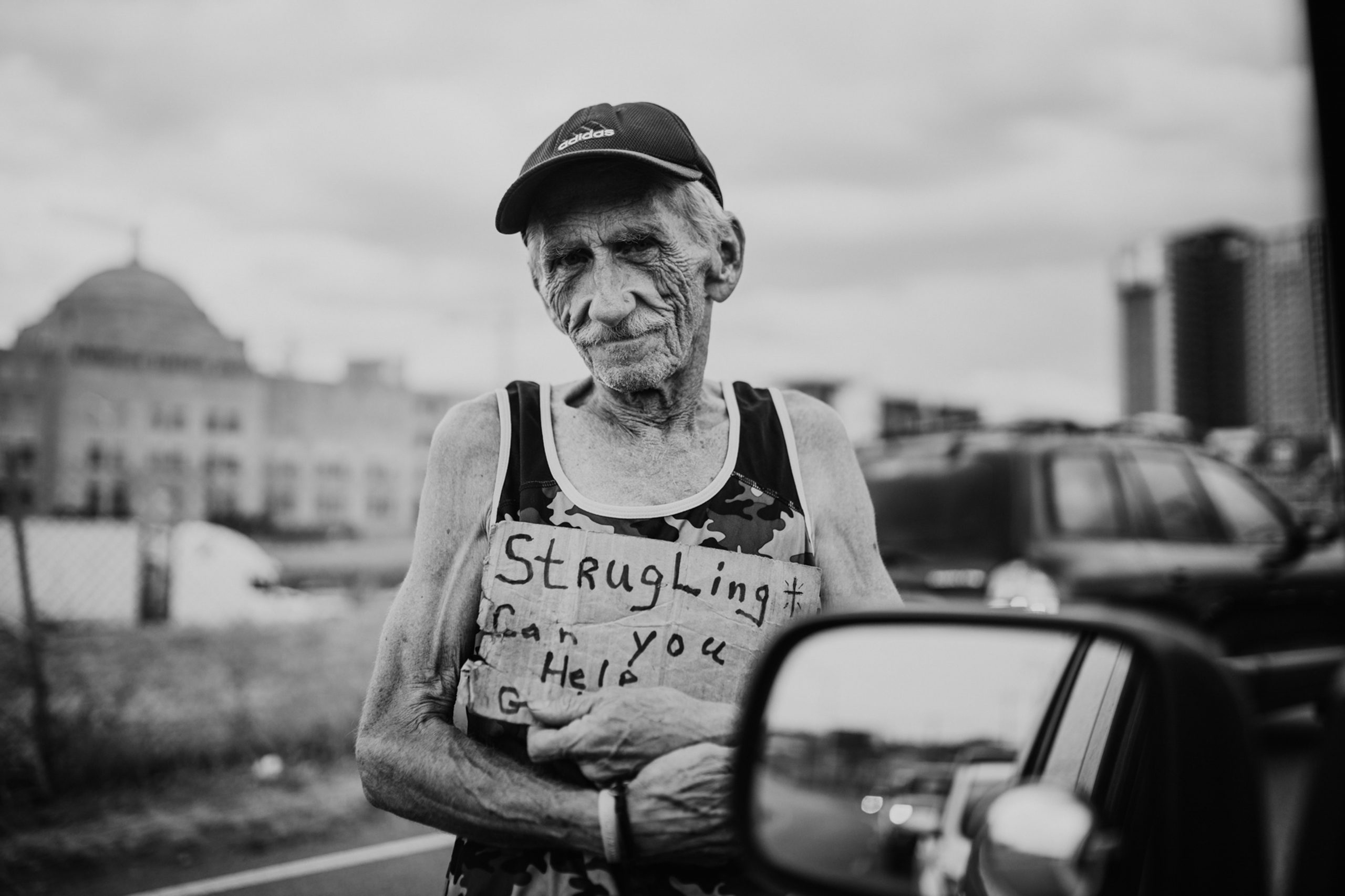
All of this came flooding to my mind as I searched my car, frantically looking for some change to give to the man in dilapidated clothing who walked up the median next to me. It wasn’t the first time I sat at a stoplight, looking at a person in the situation that I had once been.  And It was clear he had put all his hope in what was written on the cardboard he held up every time the traffic stopped.

I didn’t know this man. I didn’t know where he came from. But I knew exactly what his eyes were saying. And as it became clear that I had no change to give him, I began to feel the anxiety rise in my chest. It was the same anxiety I always felt anytime I passed a homeless person looking for help. Knowing that my current position was largely due to the kindness of strangers and friends makes it difficult for me to drive past someone I could have been if not for the generosity of others. The light turned green and I pulled away, ashamed that I didn’t have the forethought to give to a community that I was once a part of.

And suddenly, my thoughts surrounding comfort and joy became much clearer. Knowing that the situation was so dire and that my version of comfort and joy this year would be built in large part on accessing comforts he couldn’t, I began to ask what comfort and joy meant to me. I began to wonder if I had ever truly experienced either one.

Contrary to what my brain tells me, just because I’ve been homeless does not mean I am responsible for solving the entire issue of homelessness every time I sit at an intersection. But it does make me think more critically about those two forces, comfort and joy.

Oh tidings of comfort and joy
Comfort and joy
Oh tidings of comfort and joy

Tidings of comfort and joy. Though an archaic definition these days, the word “tidings” in the original context meant “news or information.” In other words, it meant bringing news of comfort and joy. Now, I imagine that this is a reference to the Gospel, known to Christians as the “good news.” And as I sat with those words awhile, a lightbulb went off.  It occurred to me that the burden of hope that underscored the lyric was the very same that filled my heart. 

It became clear to me that the pursuit of comfort and joy for myself meant the pursuit of comfort and joy for others.


If you are like me and want to put this sentiment into action, here are 6 easy ways to bring comfort and joy to others this holiday season:

  1. If you have spare change, spare it.
  2. Have toys to share? Donate them.
  3. Take time to connect with a friend.
  4. Doing online shopping? Select a charity on Amazon Smile.
  5. We’re all in a rush, practice radical patience. 
  6. Find new ways to put a smile on someone’s face.

Ghosts Are All Around Us

Picture by Nancy Kitch

My class visited the Castillo de San Marcos in Saint Augustine, FL, on a first-grade field trip. Tucked within The Castillo are two rooms connected by a narrow crevice—just the size for a first-grader to fit through. The tour guide led us through The Castillo, relaying its storied history, culminating in our visit to the first of these rooms. We children were each invited to crawl into the passage and witness what lay on the other side. Wriggling through, I couldn’t believe what I beheld on the other side: nothing. Until a chill swept over me. The energy of the tiny room behind the wall felt animate. It felt like another person was there with me. My first-grade mind was made up: I was sharing this space with a ghost.

Now older and wiser, I feel silly applying any supernatural label to the experiences of a first-grader. We, adults, aren’t supposed to believe in ghosts, right? But what if I told you they surround us?

Put away your proton pack though, the ghosts around here aren’t the Ghostbusters kind. The souls I’m referring to, multitudinous yet often overlooked, are identity ghosts. Not ghosts in any metaphysical sense, but people—human beings—who have no access to valid identification documents through some misfortune and thus are invisible to society.

To live without identification, for many, feels like not living at all. Being unable to prove who you are leaves a person feeling more like a ghost than a human.

The label of “ghost” is often self-applied by people enduring the loss of their identification documents. A former IDignity client, Joe described living without identification: “without those credentials in our society…we’re non-entities.”

Societal exclusion renders many who are living without identification feeling more spectral than human. Because the truth is: living without identification documents can be a waking nightmare.

People without identification can’t pick up their prescriptions, rent a hotel room for the night, get hired for a new job, receive government benefits, the list goes on. After receiving his identification documents, Joe stated simply, “today, I am viable.”

I find his use of the word viable more than a mere term of art. “Viable” originates in the Latin word vita, meaning life. To become viable is to become capable of living. Identification is such a significant possession that to be without it renders you inviable—incapable of living.

To be an identity ghost feels like a permanent state for many. It’s not, though. When discussing people who have no valid identification documents, we’re discussing only their present state. It’s important to remember these people, though without identification, are not without identities. To take a myopic view of the present would leave the past and the future out entirely. Take, for example, our former IDignity client, Chris. He served in the U.S. Army before his identification situation. And in the years after resolving his identification struggle, Chris has found new employment and gotten himself a place. Life doesn’t begin and end at identification, but access to identification empowers people to live.

So, dear reader, ghosts walk among us. Not the haunting kind I encountered as a child, nor the slimy Ghostbusters kind, but real human beings on whom ghostliness has been unceremoniously forced. These identity ghosts can no longer inhabit the same plane of opportunity as we all do because so much of society is closed off to those without identification.

But, there is a light in the darkness for the people trapped between the worlds of opportunity and exclusion. IDignity is dedicated to helping these individuals regain their identities and their lives.

###

Written By: Liam King

Headshot of Liam